Buying property in Spain: costs on top of the purchase price · including property purchase tax
ITP purchase tax, notary fees, land registry and lawyer: the full cost overview for buyers in Spain. ITP is the transfer tax on a resale purchase. As a property purchase tax in Spain, it is set by region, so the rate depends on where you buy.
Costs of buying property in Spain: what percentage do they add to the purchase price?
Buyers in Spain pay roughly 10 to 13 % on top of the purchase price in additional costs. The largest item is the regional transfer tax, ITP on a resale, plus notary, land registry, lawyer and NIE. Banks finance part of the purchase price, not the costs, so you cover them from equity.
Property purchase tax Spain: understanding regional ITP
The regional transfer tax, ITP, is the largest cost, with standard regional rates of 6 to 13 %. Purchase costs in Spain must be paid from your own funds, in addition to your share of the purchase price.
How high are the purchase costs? In Spain 10–13% of the price — the largest item is the regional ITP (transfer tax, 6.5–13%), plus notary, land registry, lawyer and NIE. Getting your NIE.
Are they on top of the equity? Yes — the standard Spanish purchase mortgage does not cover purchase costs, which come on top of equity. At 70% LTV with 11% costs you need about 41% of the price in your own funds.
Who pays the AJD on the mortgage?
Since 2018 the bank, not the buyer (Real Decreto-ley 17/2018). You pay AJD only on a new build, on the purchase deed. Financing a new build in stages.
Which items make up the cost of buying property in Spain, and why must equity cover them? The cost of buying property in Spain comes to roughly 10 to 13 % on top of the purchase price.
The largest item is transfer tax: in Spain the ITP on resale properties, whose rate varies by autonomous region, and on new builds the IVA plus AJD instead.
You also pay notary and land registry fees, legal fees and, if you arrange a mortgage, the tasación (valuation) and bank charges. Include these in your budget: the standard Spanish purchase mortgage finances part of the purchase price, while you cover the purchase costs from your own funds or separate funding.
Your own funds must cover both these costs and your share of the price. The bank calculates lending against the lower of the purchase price and tasación.
Include purchase costs in your financing plan from the start. This avoids a common shortfall at the notary appointment: having enough for the property itself but too little for the full purchase.
When buying a resale property in Spain, the ITP (Impuesto de Transmisiones Patrimoniales) applies — and its rate depends on the autonomous community. This makes a considerable difference.
Regional transfer tax rates under the autonomous tax laws, 07/2026
ITP is 6.5 % in the Canary Islands, 7 % in Andalusia, 6 % in Madrid, from 8 % in the Balearics, 9 % up to €1m in the Valencian Community and 10 to 13 % in Catalonia.
- Canary Islands, low tax burden: ITP 6.5 % on resale. New builds: IGIC 7 % instead of IVA 10 %, plus AJD 1 % on the deed.
- Andalusia (Marbella), low tax burden: ITP 7 % on resale. Regional wealth-tax relief must be checked together with the current national solidarity-tax mechanism; no blanket exemption for large fortunes should be assumed.
- Balearics (Mallorca, Ibiza), standard tax burden: ITP from 8 %, tiered up to 13 %. Increased wealth-tax allowance of €3m per person.
- Catalonia (Costa Brava), high tax burden: ITP banded 10–13 % (Decret llei 5/2025): 10 % to €600,000, 11 % to €900,000, 12 % to €1.5m, 13 % above. Lower entry prices compensate.
- Valencian Community, high tax burden: ITP 9 % up to €1m, 11 % above (since 01/06/2026, Law 5/2025). Solid rental yields partly offset this.
- Madrid, standard tax burden: ITP 6 %. Partial reductions for a main residence.
Further reading: Wealth tax in Spain — regional allowances · Mallorca — the Balearic market in detail.
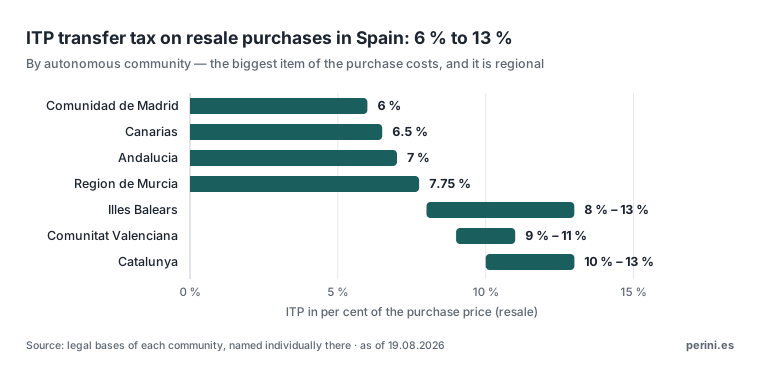
The same flat costs several percentage points of the purchase price more or less in transfer tax, depending on the autonomous community. The lowest rate is in Comunidad de Madrid at 6 %, the highest in Illes Balears at up to 13 %. Illes Balears, Comunitat Valenciana and Catalunya are graduated by purchase price — the rate rises with the price there. ITP is due when buying from the previous owner; on a new build from the developer, VAT plus AJD takes its place. Reductions granted by the communities almost always require owner-occupation, age or an income limit and are rarely attainable for non-residents.
Source: legal bases of each community, named individually there · as of 19.08.2026
Costs of buying property in Spain: a €400,000 Mallorca example
On a typical Mallorca purchase of €400,000 you pay approx. 10–11 % in costs on top:
Buying in Portugal? The purchase costs there are under IMT for non-residents.
What was actually paid in this area. Portal prices are what sellers ask. What was recorded at the notary is published by the Spanish notaries themselves: the Portal Estadístico del Notariado — free, no registration, and searchable down to postcode level.
In the first quarter of 2026 the prices paid ran 29 per cent below asking prices, the widest gap since 2007. For a mortgage that is the figure that counts: the bank's valuer works from completed sales, not from listings. → Portal Estadístico del Notariado · What that means for your financing · Where the numbers come from
Self-disclosure form for your bank enquiry
For the bank enquiry we need your key data. Fill in the bilingual self-disclosure form (DE/EN, incl. NIE) — the basis of every financing application in Spain.
Download the self-disclosure form (PDF)
Example · €400,000 MallorcaFull cost list
| Item | Amount |
|---|---|
| ITP 8 % (Balearics) | €32,000 |
| Notary (0.5–1 %) | €2,000–4,000 |
| Land registry (0.3–0.5 %) | €1,200–2,000 |
| Lawyer (1 %) | €4,000 |
| NIE application | ~€12 (state) + €200–600 (service) |
| Total costs | ~€39,500–42,500 (10–11 %) |
Model calculation, no guarantee. Actual costs vary by notary, lawyer and mortgage.
Run this calculation with your own figures →
Model calculations without guarantee. Not binding offers. Terms vary depending on credit profile, property and bank. No tax or legal advice.
Estate agent's commission in Spain: who pays it?
Unlike in Germany, in Spain the seller usually bears the estate agent's commission. For you as the buyer, this item therefore usually does not appear in your own purchase cost calculation — an exception is where the agent expressly searches exclusively for the buyer and a separate fee is agreed for this. Whether this applies to a specific offer is set out in the agency agreement or the property description.
Notary costs in Spain: what does the notarisation cost?
Notary costs are 0.5 to 1 % of the purchase price (see the list of costs above) and are based on a fee schedule set by the state, not on free agreement — the notary calculates them from the purchase price, the length of the deed and the number of copies.
With a mortgage, a second, separate notary fee is added for the loan deed, which is borne by the financing bank (see the AJD rule above). The notary appointment itself takes place once the purchase price has been agreed and the financing arranged, with the outstanding price paid at completion — it is the last step in the process, not the first.
Frequently asked questions
How high are the purchase costs in Spain?
Depending on the region, 10–13 % of the purchase price. The largest item is the ITP (transfer tax): Balearics banded 8–13 % (from €400,000 tiered up, 13 % above €2m), Andalusia 7 %, Catalonia banded 10–13 % (Decret llei 5/2025), Valencia 9 %, Canaries 6.5 %. Plus notary (0.5–1 %), land registry (0.3–0.5 %), lawyer (1 %) and the NIE application. AJD on the mortgage has been paid by the bank, not the buyer, since 2018.
Do purchase costs come on top of my equity contribution?
Yes: purchase costs come on top of the equity contribution because the standard Spanish purchase mortgage does not cover them. They require your own funds or separate funding. At 70 % LTV in Spain and 11 % costs you therefore need 30 + 11 = approx. 41 % of the purchase price in your own funds.
What does a good lawyer in Spain cost?
Typical fees: 1 % of the purchase price, at least €1,500–2,000. For purchases with more to check (developers, renovation properties) the fee is higher. A good lawyer checks charges, defects and licences — and is worth the money.
Purchase costs calculator for Mallorca: How do you work out the regional ITP?
You apply the Autonomous Community’s rate to the legally applicable tax base. In the Balearic Islands, the rate starts at 8 % and is tiered up to 13 %. The example assumes that the purchase price is also the tax base. For a resale purchase of €400,000 in Mallorca, this amounts to 8 %, or €32,000. Including the notary, land registry fees, lawyer’s fees and the NIE application, the purchase costs amount to around 10 to 11 % of the purchase price.
Who pays the AJD on a mortgage?
Not you — the bank. Since 10 November 2018 the lender is the taxable person for AJD on mortgage deeds (Real Decreto-ley 17/2018, confirmed by Ley 5/2019). It is no longer a buyer's cost and cannot be passed on to you by contract clause.
As a buyer you pay AJD only on a new build — there on the purchase deed, because that deed is subject to IVA; roughly 0.75–2 % depending on the region (Comunitat Valenciana 1.4 %).
Is there a difference between ITP and VAT (IVA) for new builds in Ibiza?
Yes. On a resale in the Balearic Islands (including Ibiza) the buyer pays ITP — a banded rate from 8 % up to 13 % above €2m. On a new build from a developer, the ITP is replaced by IVA at 10 % (the national rate; not the Canary IGIC, which does not apply here), plus AJD stamp duty on the purchase deed.
What does due diligence cost in Ibiza?
Around 1 % of the purchase price is typical for a lawyer in the Balearic Islands, as it is throughout Spain — at least roughly €1,500 to €2,000. With a developer or renovation property, the fee can be higher. The lawyer checks the Nota Simple, encumbrances and licences before signing the arras; the Gestoría handles the administrative steps afterwards.
What exactly is the ITP, and how much does it cost in 2026?
ITP (Impuesto de Transmisiones Patrimoniales) is the regional transfer tax due on a resale purchase, replacing IVA for existing properties. In 2026 standard regional rates range from 6 % in Madrid and 6.5 % in the Canary Islands to a banded 8–13 % in the Balearics and 10–13 % in Catalonia. The tax base can exceed the purchase price where a higher legally applicable property value applies.
How much are notary fees in Spain?
Notary fees typically run 0.5–1 % of the purchase price, on a sliding scale set by national tariff rather than freely negotiated. On top come land registry fees of around 0.3–0.5 % and the lawyer's fee of about 1 %.
Free mortgage advice, without obligation
We compare banks in Spain and Germany for your specific situation and find the right solution — without upfront costs.
Free · no tax or legal advice.
For a property loan, most banks only arrive at a workable calculation from a household net income of around €3,500 a month — for couples, the joint income counts.
Tell us the Spanish region, price and whether the property is new or resale. We can set the estimated taxes, notary and registry costs against your deposit and loan.
Related pages
House prices in Spain: what do buyers actually pay at the notary?
House prices Spain: the notaries publish the prices recorded in the deeds, down to postcode level — in Q1 2026, 29 % below portal asking prices.
Mortgage broker in Spain for partners: how does the partnership work?
Mortgage broker in Spain for partners: you have the contact, the financing is missing. For estate agents, developers, insurance brokers and advisers.
Licence under § 34i GewO: how can you check us before you recommend us?
Licence under § 34i GewO, register D-W-132-ZUCB-95 — verify every entry yourself with the authorities before you recommend Perini to a client.
Stage payments in Spain: which bank pays the instalments before handover?
Stage payments in Spain: the developer wants instalments during construction; the Spanish bank pays at handover. One of the 30+ lenders on the market closes that gap.
Remortgage in Spain: can you borrow against a property you own outright?
Remortgage in Spain as a non-resident: at least two of 15–20 lenders we work with will lend against an unencumbered property, as a rule up to 50 % of the valuation.
For each case, we make specific enquiries with at least 2 banks.
Buy a house in Spain with German property as security: how much can you raise?
Buy a house in Spain with capital raised against an unencumbered German property — from one desk. The obstacle is not the value; it is the loan purpose.
Mortgage calculator
Monthly payment, loan and purchase costs by region straight away; total cost and equity needed by email.
Rental licence in Spain
Regional licence, national registration number — and what the owners’ association is permitted to do.
Procedure and sequence in Portugal
CPCV, Casa Pronta and the 7.5 % IMT for non-residents since 25 May 2026.

Content by Siegfried Perini — local brand representative since 2019, active in real estate since 1992, entered in the German intermediary register (§ 11a GewO) as a person directly involved in brokerage and advice. Point of contact for German-speaking buyers in Spain and Portugal. Brokerage by Olga Nikushkina, mortgage credit intermediary under § 34i German Trade Regulation (GewO); in Portugal through a locally licensed intermediary.