New build · construction phase · Spain
Stage payments in Spain: which bank pays the instalments before handover
For stage payments in Spain on an off-plan new build, the key issue is that standard banks pay at handover. Until then, you fund the instalments yourself, and the town hall’s approval can add a further wait after construction ends. The lender we arrange pays each instalment as it falls due.
How many lenders pay stage payments in Spain directly to the developer?
One of the 30+ lenders on the market pays stage payments in Spain directly to the developer. Standard Spanish banks release funds only at handover, because the mortgage comes into existence with completion and registration. With that lender your equity goes in first, after which the bank covers each instalment in full as it falls due.
What the guide covers
- Disbursement · each instalment in full, while the building goes up
- Equity · paid in first, sized against the tasación
- Recipient · straight to the developer
- Property type · developer new build (obra nueva) — not self-build
- Lenders writing this · 1 of 15–20 lenders we work with (Perini Market Check, as at 22.11.2026)
Request by email · Financing new-build stage payments — Spain (PDF)
All figures are orientation from our brokerage practice — not a commitment and not a guaranteed condition. Whether a case works depends on the property, the valuation and your standing: subject to credit assessment, case by case, no legal entitlement.
Request the guide
We use your details to process your request and reply by email. For more information, see our privacy policy.
The developer’s payment schedule
The developer's schedule runs from reservation and private contract through stage payments across the whole build to completion (escritura), when the balance falls due and a mortgage can be registered.
- Why does the Spanish bank only pay at completion? Because an unfinished property can't be conveyed or carry a mortgage; the mortgage comes into existence with completion and entry in the Registro de la Propiedad. The Spanish banks.
- How much do you pay during construction? Typically 20 to 30% of the price (reservation, contract, progress instalments); the remainder falls due at completion and is usually covered by the mortgage.
- Does an aval finance the instalments? No — it only protects instalments already paid if the developer fails. Financing the instalments during construction is a separate step.
- Who pays the stage payments in Spain during a new build? Buyers usually fund them themselves. The gap between these payments and the mortgage drawdown is where many new-build purchases fail.
Across a build period of 18 to 36 months the developer's instalments have to come from your own capital, typically 20 to 30 per cent of the purchase price. Of the 30+ lenders on the market, one pays those instalments directly to the developer.
You pay your equity first. The bank then covers each instalment in full as it falls due, directly to the developer. Instalments are not split, and you do not have to bridge them yourself.
Then comes the town hall. Once the build is technically finished, the Licencia de Primera Ocupación is still missing. Without it there are no utility connections, no notarial deed, no keys — and banks will not approve a mortgage. Three to six months is normal; in some municipalities it drags on for up to two years (Perini Market Check, 22.11.2026). Registration adds more.
The developer requires payments as construction progresses, while a standard bank pays after the licence. Buyers can therefore need to advance millions for months. A purchase can fail for lack of available cash even when the buyer’s creditworthiness is sufficient.
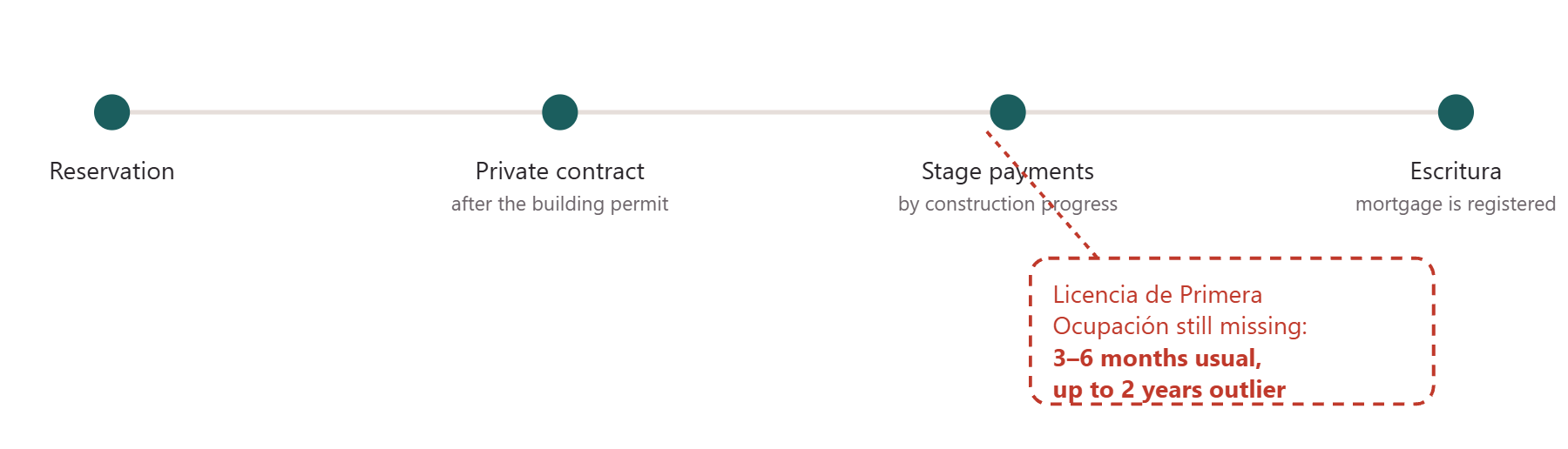
Financing a new build in Spain during construction: the usual payment schedule
With standard financing, the bank pays out at the escritura. Before then, you pay the reservation, a first larger payment under the private contract once the building permit is granted, and further instalments as construction progresses.
- Reservation. A few thousand euros to take the unit off the market.
- Private contract (contrato privado). As soon as the building permit has been granted: a first larger payment.
- Instalments according to construction progress. Monthly, quarterly or half-yearly — depending on the developer’s schedule, over the entire construction period.
- Escritura. Only now, at handover, is the remainder due — and only now can a mortgage be registered.
From the payment plan to the keys: sequence and timing
From checking the structure through reservation, the approach to at least two of 15 to 20 institutions we work with and the valuation to the keys; the realistic duration of each stage is in the table.
Row 9 describes a critical delay: the administrative process between the last stage payment and a standard bank’s drawdown. Allow for it in your cash planning even if you do not use this structure. During construction, typically 20 % to 30 % of the purchase price must come from your own funds, followed by the wait for the licence.
Sequence from checking the structure to the keys
Stage | What happens | Realistic duration |
|---|---|---|
1 · Check the structure before anything binds | payment schedule, developer, expected valuation | 1 to 2 weeks |
2 · Reservation | a few thousand euros to take the unit off the market | days |
3 · Approach at least two of 15 to 20 institutions we work with | one of the 30+ lenders on the market pays the instalments before handover | in parallel |
4 · Valuation of the scheme | valued against the specification and the payment schedule | 5 to 10 working days |
5 · Approval and disbursement plan | which instalment goes to the developer, and when | up to 10 days with a complete file |
6 · Private contract (contrato privado) | only now — a first larger payment falls due | after approval |
7 · Construction with instalments by progress | monthly, quarterly or half-yearly, following the developer's calendar | 18 to 36 months |
8 · Technical completion | the building is finished and signed off by the architect | end of the build |
9 · Licencia de Primera Ocupación | without it: no utilities, no deed, no mortgage | 1 to 3 months by law, 3 to 6 in practice — some municipalities up to 2 years |
10 · FEIN and two notary appointments | binding offer, briefing, then purchase and mortgage deeds | at least 10 calendar days from receipt of the documents; notarial record by the day before the loan deed |
11 · Escritura, registry, keys | the mortgage only comes into existence on registration | days to weeks |
What does our lender do differently?
The standard financing range for non-residents is 60 to 70 per cent, with a ceiling of 70 per cent of the lower of price and tasación. Standard banks offer this range too. This lender differs in when it pays: you put in your equity first, sized against the tasación, and the bank then pays every developer instalment in full as it falls due, directly to the developer. You do not bridge those payments yourself.
A reliable completion date, in writing. Verbal dates are insufficient for both the bank’s assessment and your own planning.
The purchase costs exist on top. On a new build, IVA and AJD alone come to around 11.4 %. The bank finances the price, not the tax.
It is not a commitment. Treat every number here as an estimate drawn from our brokerage practice, not a promise or a locked-in condition.
Which lender does this is not on this page. There is one, the access took years to build, and it holds only while it stays out of the mass market. You get the name when we set your case up.
Which purchases qualify for this stage-payment structure?
This is about buying from a developer — obra nueva with a building permit and a bank guarantee.
Suited to and not suited to: stage payments on a new build
Suited to | Not suited to |
|---|---|
Developer new build with a building permit and an aval | Autopromoción — self-build on your own plot follows different rules |
Buyers who have not yet signed the payment schedule | Cases where the private contract already binds and the calendar is fixed |
Properties whose valuation supports the price | The expectation that the bank will finance a valuation gap |
Buyers whose liquidity should not have to bridge the build | Bridging finance without property security — a different product |
Cases where the first bank has already walked away | Refurbishment or conversion of an existing property — a different structure applies |
What can prevent stage-payment financing?
The main obstacles are a developer without a building permit or bank guarantee, signing contracts in the wrong order, a tasación below the price and insufficient own funds for purchase costs.
- The developer. Without a building permit, without a bank guarantee (aval) for the payments made and without a reliable completion date, the structure cannot be put together. The creditworthiness of the promotora is checked as well — not only yours.
- The order. Arrange financing before signing the private contract. Once you have signed, the payment schedule is fixed and your negotiating position is weaker. The financing must then fit that schedule.
- The tasación. Valuations of new builds do not automatically come in at the sale price. You pay the difference.
- Purchase costs treated as financeable. IVA and AJD are equity and fall due before the loan is paid out.
Which bank does this is not stated on this page. It is a single one, the access has grown over years, and it only lasts as long as it does not become mass business. You will learn the name when we set up your case.
Where do you stand?
All three cases reach us. All three are solvable — but not equally well at every stage.
- You have a property in view — and have signed nothing yet: The best moment. We check the developer's payment schedule before it binds you. Have your case checked.
- Your bank promised — and withdrew: A verbal yes, the valuer comes out, then: we must wait for handover. The reservation is signed, the money is committed, the purchase wobbles. This case reaches us regularly — and it is solvable while the building has not been signed off. Have your case checked.
- You have already paid — and are waiting for handover: The capital is stuck, nothing is registered, there is no mortgage. Even then it is not over: up to 70 % of the tasación can be raised afterwards — even where you went in with far more equity. But the window is narrow. Have your case checked.
- The window. Ideally before handover. Once the building has been signed off, our experience is that only a short window of a few months remains for financing and registration.
Where exactly that window closes is set by the lender — it is not a statutory deadline, and we treat it case by case. Whoever misses it is no longer a buyer arranging finance but the owner of a paid-off property.
Then only the existing-property route remains: as a rule up to 50 % of the tasación instead of 70 %, with the use of funds tied. Twenty percentage points on a seven-figure sum.
Many buyers only find us after abandoning a new-build purchase. Their creditworthiness would have supported it, but they could not find financing for the construction instalments. This is the gap we close.
On Ibiza, who pays the instalments: the bank or your reserve?
Equity in first, then every instalment paid in full from the loan
A couple buys a new-build villa in Es Cubells from a developer; construction takes around 24 months. A standard Spanish bank pays only at handover — and after the build ends, the Licencia de Primera Ocupación still takes three to six months in practice. Until then the buyer would have to bridge.
Purchase price (= tasación): €4,500,000. Developer new build, not self-build.
Purchase costs (approx. 13 %): €585,000. IVA, AJD, notary and registry.
Equity paid in first: €1,350,000. Sized against the tasación.
Loan: €3,150,000. Every further instalment is paid in full from the loan.
Buyer’s bridge after the equity is in: €0. The bank pays when each instalment falls due.
With standard financing, until handover + LPO: the buyer advances every further instalment from available cash, often for months.
The difference is not the ratio, it is the bridge. As a rule the buyer carries every instalment until handover — and then waits for the licence. Here the bank pays as each instalment falls due.
And the other side of it: Total loan €3,150,000, secured on the new-build property. Own funds across the transaction: €1,935,000. The disbursement schedule follows the developer's payment plan and the lender's offer.
Note: This worked example is based on typical financing situations from our practice. All amounts, persons and property data are anonymised or illustrative. It is not a customer testimonial. Every financing is assessed individually against personal standing, the property valuation (tasación) and the lender's own criteria.
Region: Property finance in Ibiza
Costa Blanca worked example: assumptions and figures
Assumptions, all our own: a developer new build on the Costa Blanca (Comunitat Valenciana), purchase price €500,000, valuation equal to the price, build time 24 months, term 20 years. Not an offer and not a commitment.
This is how the €150,000 of equity flows: €6,000 at reservation, €100,000 with the private contract and the remaining €44,000 with the final payment at the escritura. The bank pays the four stage payments (€200,000) in full and directly to the developer. The purchase costs of €66,412 come on top, from own funds.
Worked example: new build on the Costa Blanca
Item | Amount | Where the figure comes from |
|---|---|---|
Purchase costs in total | €66,412 | 13.3 % — above the 10 to 13 % band, because IVA and AJD alone come to 11.4 % |
Loan, 70 % of the lower of price and valuation | €350,000 | the market-standard cap for non-residents |
Equity, paid in first | €150,000 | sized against the valuation |
Bridging required once the equity is in | €0 | the bank pays each instalment as it falls due |
Bridging as a rule, up to the deed | €100,000 to €150,000 | stage payments of 20 % to 30 % of the price out of your own liquidity |
Our services and brokerage fee for stage-payment financing
We take on the pre-check, the selection of lenders, the documents, the contract check and support up to the notary; our fee is 1 % of the loan actually arranged.
A check before you sign. You hear whether the structure holds before the preliminary contract — not after the deposit has left your account.
- A selection of lenders, not a branch visit. We work with 15 to 20 institutions and approach at least two of them per case: major Spanish banks, regional cajas, non-resident specialists and international lenders. What counts is who writes the structure, not who calls it conceivable (Perini Market Check, as at 22.11.2026).
- Documents in bankable form. We sort them, have them translated and file them — with a complete file, processing runs from 3 days to 4 weeks.
- Contract check. The arras contract and the payment schedule are reviewed before they bind you.
- Support up to the notary. Two appointments, the ten-day FEIN period, the registry entry — the order of events is half the battle.
Our fee is 1 % of the loan actually arranged — not of the purchase price — falls due only if the financing completes, and carries no VAT. If no financing materialises you pay nothing: no advance payment, no handling charge. If the loan ends up smaller than planned, the fee shrinks with it.
Financing new-build stage payments in Spain: what does the PDF guide cover?
How the structure works, what breaks it, which documents the lender wants to see and in which order to proceed.
Free, by email, no upfront cost.
Frequently asked questions: Stage payments in Spain
Why does the Spanish bank only pay at completion?
Because an unfinished property cannot be conveyed before a notary and therefore cannot carry a mortgage. Without registrable security there is no loan. The mortgage comes into existence with completion and entry in the Registro de la Propiedad.
I’ve already paid for the property in full — is there anything else I can do?
Yes. You can subsequently secure financing for up to 70 % of the tasación, even if you started out with significantly more equity. The timing is crucial: ideally before the building is signed off. After that, there’s only a short window of opportunity, and anyone who misses it ends up borrowing against an existing property — usually up to 50 % rather than up to 70 %.
How much must I pay during construction in Spain?
Typically 20 to 30 per cent of the purchase price: reservation, a payment on signing the private contract, and instalments as building progresses. The remainder falls due at completion and is usually covered by the mortgage.
Is this the same as a self-build mortgage (autopromoción)?
No. Autopromoción is self-build on your own plot; staged disbursement is standard there and several lenders offer it. This is a purchase from a developer, where the buyer normally funds the construction period personally.
Do I need to bring equity?
Yes, and it comes first. The amount depends on the tasación (valuation). Only after that does the bank take over each instalment in full — nothing is split, nothing is deferred.
Can I take over the developer's mortgage instead (subrogación)?
Often, yes — but it also only applies from handover. It doesn't solve the construction-period problem, it just shortens the path to final financing. And since the 2019 reform it's no longer automatically the cheaper option; it needs to be compared against the alternative.
Isn't a bank guarantee (aval bancario) enough on its own?
No — it answers a different question. An aval bancario or surety bond protects the instalments you've already paid: if the developer fails, that money comes back. The instalments themselves still have to be paid from your own funds in the meantime. Financing those instalments during construction — the subject of this page — is a separate, second step.
I've already paid some instalments. Is it too late?
Not necessarily. The later you arrange financing, the less room there is to adjust the plan. Payments already made cannot be restructured; we can assess the instalments still due. Send us your payment schedule so we can check what remains possible.
Before you sign the private contract
Send us the developer's payment schedule and the key facts of the property. We will tell you whether the structure holds in your case — beforehand, not afterwards.
For a property loan, most banks only arrive at a workable calculation from a household net income of around €3,500 a month — for couples, the joint income counts.
Related pages
Case study · New build · Spain
New build paid for in full, sign-off of the building pending: financed instead of a two-year wait
Of the 30+ institutions on the market, one pays the stage payments before the building is signed off; this, not creditworthiness, is where new-build purchases by non-residents fail.
New build in Spain · Self-build
Buying a plot of land in Spain: Who will finance the construction of your house afterwards?
There is a Spanish financing scheme that pays out as construction progresses. However, it only applies if you are building the property yourself — not if you are buying from a developer.
Structure · two countries
Additional borrowing against the German property: How does it complement a Spanish mortgage?
If there is already a loan in place, the new mortgage will be subordinated to it; the existing charge and the new loan combined must remain within the limit.
Existing property · releasing capital · Spain
Release capital from an existing property
Remortgage in Spain as a non-resident: at least two of 15–20 lenders we work with will lend against an unencumbered property, as a rule up to 50 % of the valuation.
Age
Age limit for mortgages
Why a ‘no’ often turns into a ‘yes’ when a younger second borrower is added to the land register (minimum share: 10 %).
Financing structures · Spain
All three structures
Special financing in Spain: stage payments during construction, capital from a paid-off Spanish property, German security, equity raised at home.
Calculator
Mortgage calculator
Monthly payment, loan and purchase costs by region straight away; total cost and equity needed by email.
Structure · Capital privado
Private mortgage lender in Spain: when is it the right route?
We arrange it from €250,000, and only once the bank route has been tested and no bank will write the case. It costs a multiple of bank finance.
New-build
Construction phase financing in Spain: why won't the standard bank pay?
Construction phase financing in Spain: the mortgage only comes at completion, so off-plan instalments of often 20 to 30 per cent are your own money.
Capital raising · cross-border
Property as security for a loan: Can the money be transferred to another European country?
As a rule, up to 50 % of the tasación is possible — not the rate that applies on a purchase, because with an existing property no purchase price confirms the value.
Fill-in template · Free
Self-disclosure form: What do banks in Spain and Portugal want to know?
Your financial details are set out in the self-disclosure form before any application is submitted — which is why this form alone is enough to tell whether a case has merit.
New Build in Spain · Timing
Mortgage approval for a new-build property in Spain: When does it come before the escritura?
Delays of a few months are common. The key factor is whether the contract grants you a genuine right to withdraw once a specified time limit has been exceeded.

Content by Siegfried Perini — local brand representative since 2019, active in real estate since 1992, entered in the German intermediary register (§ 11a GewO) as a person directly involved in brokerage and advice. Point of contact for German-speaking buyers in Spain and Portugal. Brokerage by Olga Nikushkina, mortgage credit intermediary under § 34i German Trade Regulation (GewO); in Portugal through a locally licensed intermediary.
Last updated: 23.11.2026